

Nervous mortality syndrome (NMS) is an infrequent but important health issue that fish health professionals should be aware of. In Irish marine Atlantic salmon farming, NMS has been reported occasionally, including within the past year. This article highlights what is currently known about NMS, what to look for in the field, and why early recognition and thorough investigation matter.
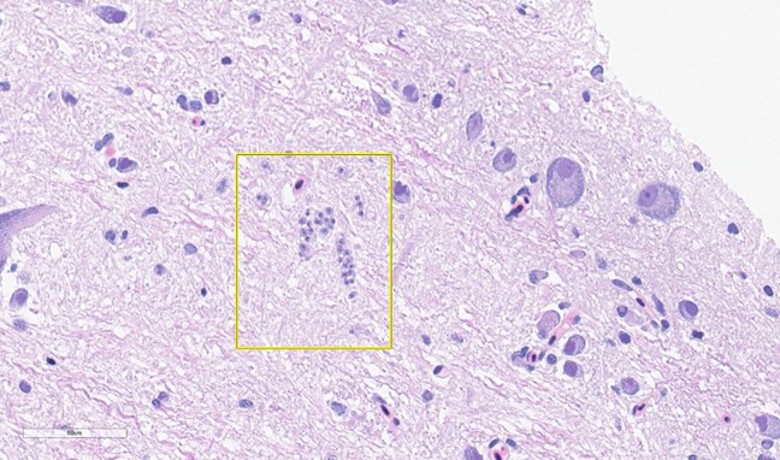
Picture above: Presporogonic stages of the NMS agent showing as circular/oval basophilic structures in the brain tissue of Atlantic salmon © Mar Marcos Lopez, PHARMAQ Analytiq
Nervous Mortality Syndrome (NMS) is a uncommon disease affecting Atlantic salmon in the early marine stage, caused by an unclassified myxosporean parasite thought to belong to the genus Myxobolus1,4. A similar disease is well-known in rainbow trout, known as ‘Whirling Disease’- however while Whirling Disease is caused by Myxobolus cerebralis and primarily targets skeletal cartilage in freshwater, the NMS agent is a distinct marine parasite that is associated with parasitic stages in CNS tissue. Because NMS typically impacts post-smolts within six to eight weeks of sea transfer, its life cycle is believed to involve a marine or brackish-water invertebrate intermediate host (such as an oligochaete or polychaete). However, the exact transmission dynamics and definitive hosts remain unknown.
The disease is primarily known from case descriptions from Ireland in the 1990s2, although our diagnostic service is aware of a single historical detection in Scotland in the early 2000s. While rare, NMS has also been identified in Ireland in 2026.
For those unaware, genetic sequencing has shown that myxosporean parasites such as the NMS and Whirling Disease agents are actually highly evolved and simplified cnidarians- meaning they’re essentially micro-jellyfish which have adapted into a parasitic lifestyle.
The syndrome primarily manifests during a cohort's first summer at sea.2,1,3 In some cases, a rise in unmarked mortality may be the principle observation. Early clinical signs include a notable drop in appetite and generalized lethargy, with affected fish clustering near the net surface. As the disease progresses, salmon exhibit striking neurological symptoms: erratic circling, sudden frantic bursts of surface swimming, disorientation, and a temporary loss of equilibrium. In acute epizootics, cumulative mortality can escalate rapidly, historically exceeding 90% within a month, though survivors typically develop strong immunity and resume normal growth.2
Definitive diagnosis relies on histopathological evaluation of the central nervous system (brain tissue). Under light microscopy, intercellular presporogonic (developmental) stages of the parasite appear as distinct strings or clusters of basophilic, circular-to-ovoid cells measuring 5 to 9 µm in diameter, often enclosed within a visible capsule.2 These structures are distributed throughout the brain—particularly the cerebellum, optic tectum, and mid-brain—as well as the spinal cord. The accompanying pathology is characterized by non-purulent encephalitis and encephalomyelitis, featuring multifocal areas of gliosis, microglial activation, perivascular cuffing, and focal necrosis in severe cases.1
Currently, there are no licensed therapeutic treatments or vaccines available for NMS. Management relies entirely on preventative biosecurity and stress mitigation. Because outbreaks closely align with the stressful window of seawater adaptation, optimizing smolt quality and avoiding handling or transport stressors during high-temperature periods is critical. Fallow periods, strict biosecurity protocols, and rapid mortality removal to eliminate potential spore reservoirs represent the primary containment strategies for marine farms.
References
1 Frasca, S., Poynton, S. L., West, A. B., & Van Kruiningen, H. J. (1998). Epizootiology, pathology, and ultrastructure of the myxosporean associated with parasitic encephalitis of farmed Atlantic salmon Salmo salar in Ireland. Diseases of Aquatic Organisms, 32(3), 211–225. https://doi.org/10.3354/dao032211 Cited by: 15
2 Rodger, H. D., Turnbull, T., Scullion, F. T., Sparrow, D., & Richards, R. H. (1995). Nervous mortality syndrome in farmed Atlantic salmon. Veterinary Record, 137(24), 616–617.
3 Scullion, F. T., Scullion, M. G., Sparrow, D., Rodger, H. D., & Sheahan, B. J. (1996). Encephalitis and mass mortality of farmed salmon smolts in an isolated sea bay in Ireland. Veterinary Record, 138(7), 161-162.
4 Frasca, S., Linfert, D. R., Tsongalis, G. J., Gorton, T. S., Garmendia, A. E., Hedrick, R. P., West, A. B., & Van Kruiningen, H. J. (1999). Molecular characterization of the myxosporean associated with parasitic encephalitis of farmed Atlantic salmon Salmo salar in Ireland. Diseases of Aquatic Organisms, 35(3), 221–233. https://doi.org/10.3354/dao035221
Head office/Production facilitySkogmo IndustriområdeIndustrivegen 50N-7863 Overhalla, NorwayTel:+47 74 28 08 00
PHQ.customer.service@zoetis.com


PHARMAQ is the global leader in vaccines and innovation for aquaculture and part of Zoetis, the world leader in animal health. The company provides environmentally sound, safe and efficacious health products to the global aquaculture industry through targeted research and the commitment of dedicated people. Production facilities, administration and research and development activities are based in Norway with subsidiaries in Chile, United Kingdom, Vietnam, Turkey, Spain, Panama and Hong Kong. PHARMAQ has approximately 300 employees. The company's products are marketed in Europe, North and South America, and Asia. For further information, visit the company's website at www.pharmaq.com. Privacy Policy. Cookie Policy. Terms of Use.
Copyright © 2020 Zoetis LLC. All rights reserved.